
Why Your Nail Salon Keeps Losing Clients It Already Won (And How to Fix Rebooking)Vì Sao Tiệm Nail Đông Khách Vẫn Mất Khách Quen: Lỗ Hổng Trong Quy Trình Mời Khách Quay Lại

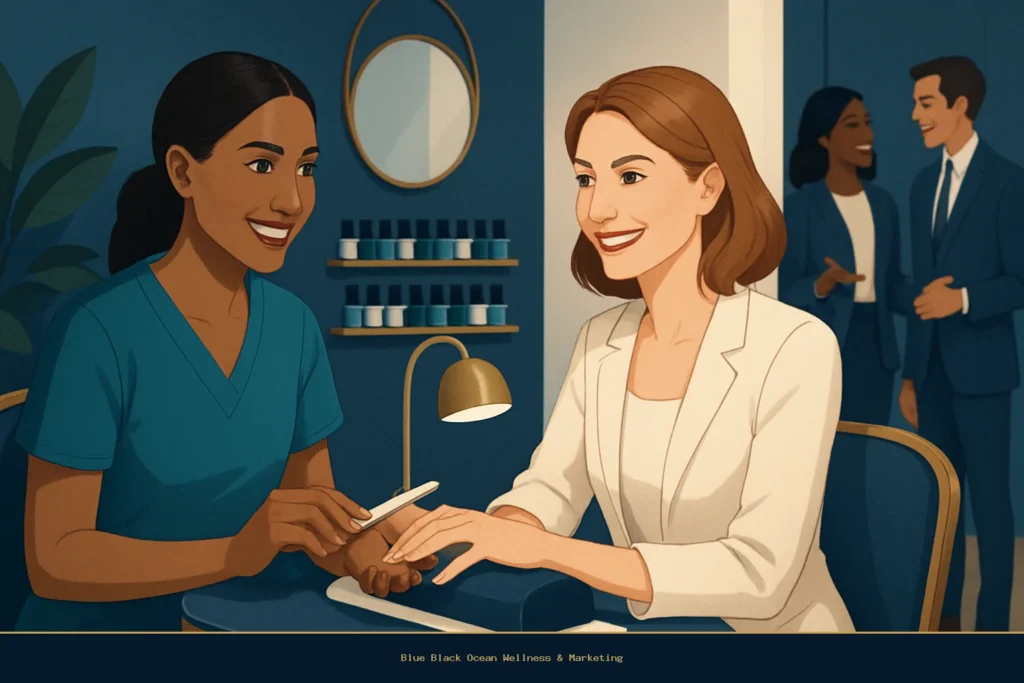
It is Tuesday afternoon, and a nail salon owner is staring at an appointment book that is half empty. Two weeks ago, the same book was packed solid, thanks to a social media promotion that pulled in a wave of new clients. Now most of those chairs sit open, and many of those same faces have not come back. Her instinct is to run another promo to fill the gap. But the real problem was never a shortage of new clients. It was that not one of those first-time clients was ever asked, prompted, or reminded to return.
Table of Contents
- The Uncomfortable Truth
- Why the Gap Exists
- Key Takeaways
- A Simple Three-Part Rebooking System
- 1. Offer the Next Appointment Before the Client Leaves the Chair
- 2. Maintain a Basic Client List
- 3. Send a Friendly Follow-Up Message
- Reinforce It With Consistent Content
- Industry Scenario: What Changes When the System Is in Place
- How Blue Black Ocean Approaches This Problem
- Your Action Plan for This Week
- Measuring Progress Without Guessing
- Frequently Asked Questions
- How often should a nail salon follow up with clients?
- Do we need expensive CRM software to track clients?
- Will offering the next appointment at checkout feel too pushy to clients?
- Should follow-up messages always include a discount?
- A Practical Next Step
This is one of the most common and most fixable issues in nail salon marketing: strong client acquisition, weak client retention. The salon knows how to get someone in the chair once. It has no system for getting that person back on a predictable cycle.
The Uncomfortable Truth
Most nail salons do not have a marketing problem. They have a rebooking problem that gets mistaken for a marketing problem. Owners keep pouring time and ad spend into attracting new walk-ins and first-time bookings, while the clients they already won quietly drift to a competitor, or simply forget to schedule again. This is a leaky bucket: new clients pour in at the top while existing ones leak out the bottom, and no amount of additional social posting fixes a hole that marketing was never designed to patch.
The uncomfortable part is this: retaining an existing client is generally far more cost-efficient than acquiring a new one, yet most salons build their entire marketing effort around acquisition and treat retention as an afterthought, if they think about it at all.
Why the Gap Exists
The root cause is not a lack of effort. It is a missing structure. Look closely at a typical client visit and you will usually find:
- No specific moment at checkout where the next appointment is offered or scheduled.
- No client list that tracks names, phone numbers, last visit date, and typical service or cycle.
- No follow-up message sent when a regular client passes their usual rebooking window without an appointment.
- Marketing content that stops at “come try us” and never reinforces “come back.”
In other words, the salon’s marketing effort ends the moment a new client books their first visit. Everything after that first appointment is left to chance and memory, and memory is not a retention strategy.
Key Takeaways
- New clients are only half the job. A full nail salon marketing system includes a plan for what happens after the first visit, not just before it.
- Rebooking is a moment, not a hope. If the next appointment is not offered at checkout, most clients will not think to schedule it themselves.
- A simple client list beats no client list. Even a basic spreadsheet with name, phone number, last visit, and typical service is enough to spot who has gone quiet.
- Follow-up should feel like an invitation, not a discount chase. A warm reminder often works better than another promo code.
- Content should remind, not just attract. Consistent, current photos and video of real work keep the salon top of mind between visits.
A Simple Three-Part Rebooking System
Fixing this does not require new software or a bigger marketing budget. It requires a defined process that every technician and front desk staff member follows consistently.
1. Offer the Next Appointment Before the Client Leaves the Chair
Train technicians and front desk staff to say one specific sentence at checkout, something like: “Based on how your gel usually grows out, you’ll probably want to come back in about three weeks. Want me to go ahead and book that for you now?” This single habit converts a passive hope into an active decision made while the client is still sitting there, satisfied with their new nails.
2. Maintain a Basic Client List
This can be a simple spreadsheet or built into salon booking software. At minimum, track:
- Client name and phone number
- Last visit date
- Typical service and usual rebooking cycle (commonly two to four weeks for most nail services)
This list is the tool that makes the next step possible. Without it, there is no way to know who has quietly stopped coming.
3. Send a Friendly Follow-Up Message
Once a client passes their typical rebooking window without an appointment, someone should reach out with a short, warm text or Messenger note, an invitation back, not a hard-sell discount. Something as simple as checking in and asking if they would like to grab a spot this week can be enough to bring a client back into the cycle.
Reinforce It With Consistent Content
Website and social content should show current, real work so clients remember why they chose this salon in the first place. If the last photos posted are from six months ago, a client has little visual reason to think of the salon when it is time to rebook.
Industry Scenario: What Changes When the System Is in Place
Consider a composite Industry Scenario based on common patterns across mid-size nail salons: clients genuinely enjoyed their visit, but months would pass, if they returned at all, before booking again. After the owner introduced a simple checkout rebooking prompt and a basic follow-up message for clients approaching their typical rebooking window, something changed. Clients began booking their next appointment before leaving the chair, and long gaps between visits for regular clients became noticeably less common. No specific numbers are claimed here, only the observable shift in client behavior once a structure replaced hope.
How Blue Black Ocean Approaches This Problem
Blue Black Ocean starts by diagnosing exactly where the rebooking process breaks down: is it a missing checkout conversation, an absent follow-up system, or content so inconsistent it fails to remind past clients the salon exists? From there, the work is practical. Blue Black Ocean records video on-site, capturing real technicians and real nail designs rather than generic stock content, and publishes that content consistently on the salon’s fanpage so the business stays visible between visits, not just at the moment of the first booking. Blue Black Ocean also builds or improves the salon’s website into an online showroom, giving prospective and returning clients a clear, current view of styles, atmosphere, and service options before they decide to book again. This is documented, verifiable work completed for Royal Nails Salon Spa: on-site video, consistent design and salon content posting, and a website functioning as an ongoing showroom.
The priority throughout is always the same: fix the leak before adding more water. Attracting new clients matters, but not at the expense of a system that keeps the clients already earned.
Your Action Plan for This Week
- Owner or manager: Ask every technician to use one specific checkout sentence suggesting the client’s next appointment date based on their typical service cycle.
- Front desk: Write down that suggested date on a card or directly into the booking system, even if the client does not book on the spot.
- Owner or manager: Pull a list of clients who have not visited in five to six weeks.
- Owner or designated staff member: Send each of those clients one short, warm follow-up message inviting them back.
- Review signal: At the end of the week, note how many clients booked a next appointment at checkout versus how many left without one. That single number is your baseline for measuring improvement.
Measuring Progress Without Guessing
Set a simple baseline this week: the percentage of checkouts where a next appointment was offered and the number of follow-up messages sent to lapsed clients. Review that same tracking after seven days, then again after roughly four weeks. Leading indicators to watch include how many clients rebook on the spot and how many respond to a follow-up message. The business outcome to watch over time is a steadier, more predictable appointment book, week to week, rather than sharp peaks after a promotion followed by empty stretches.
Frequently Asked Questions
How often should a nail salon follow up with clients?
It depends on the typical service cycle. Most nail services fall into a two to four week rebooking window, so a good rule of thumb is to check in with clients once they pass their usual cycle by a week or two without booking.
Do we need expensive CRM software to track clients?
No. A basic spreadsheet with name, phone number, last visit date, and typical service is enough to start. The point is having any structured list, not necessarily an advanced tool.
Will offering the next appointment at checkout feel too pushy to clients?
Generally not, when it is framed as a helpful suggestion tied to their own nail growth cycle rather than a sales pitch. Most clients appreciate the convenience of having it already scheduled.
Should follow-up messages always include a discount?
Not necessarily. A warm, personal check-in inviting the client back often works as well as, or better than, a discount, and it protects the salon’s margins.
A Practical Next Step
If your appointment book looks full one week and empty the next, the issue is rarely a lack of new clients. It is usually a missing rebooking system. Blue Black Ocean offers a Free Marketing Direction Review to help nail salon owners see exactly where their rebooking process breaks down, from the checkout conversation to content that should be reminding past clients to return. There is no guarantee attached, just a clear, honest look at where the leak is and what a workable fix looks like for your specific salon.
Trả lời nhanh: Tiệm nail mất khách quen không phải vì tay nghề kém, mà vì không có bước cụ thể mời khách đặt lịch lần tới ngay tại quầy thanh toán và không theo dõi ai đã lâu chưa quay lại. Xây quy trình mời quay lại quan trọng hơn việc chỉ chạy quảng cáo tìm khách mới liên tục.
Mục lục
Chủ tiệm nào cũng từng trải qua cảnh này: tuần trước lịch kín, tuần này ghế trống quá nửa. Bạn nhìn lại danh sách khách, nhận ra nhiều gương mặt quen của tháng trước giờ không thấy đâu. Phản xạ đầu tiên là đăng thêm một chương trình khuyến mãi để kéo khách mới. Nhưng vấn đề không nằm ở việc thiếu khách mới, mà ở chỗ khách cũ không được mời quay lại đúng lúc.
Sự thật cần nhìn thẳng
Tiệm nail thường dồn phần lớn công sức marketing vào việc thu hút khách lần đầu: chạy quảng cáo, đăng bài mẫu nail đẹp, làm chương trình giảm giá cho khách mới. Đó là bước cần thiết. Nhưng công việc marketing không dừng lại khi khách rời khỏi ghế lần đầu tiên.
Nếu không có bước cụ thể để mời khách đặt lịch lần kế tiếp, phần lớn khách sẽ quên. Không phải vì họ không hài lòng, mà vì cuộc sống bận rộn và không ai nhắc họ. Kết quả là tiệm liên tục phải tìm khách mới để bù vào chỗ trống của khách cũ đã rời đi, giống như đổ nước vào một cái thùng bị rò rỉ ở đáy.
Hậu quả kinh doanh rất rõ ràng. Doanh thu lên xuống thất thường theo từng đợt quảng cáo. Thợ nail có tuần kín lịch, có tuần ngồi không. Chủ tiệm phải chi tiền quảng cáo liên tục thay vì tận dụng nguồn khách đã từng đến, vốn dễ thuyết phục quay lại hơn nhiều so với thuyết phục một người hoàn toàn mới.
Nguyên nhân gốc thường không phải do tiệm thiếu khách tiềm năng trong khu vực. Vấn đề là không có ai trong tiệm chịu trách nhiệm nhắc khách đặt lịch tiếp theo, và không có danh sách theo dõi khách theo chu kỳ (ví dụ 2 đến 4 tuần cho làm nail thông thường) để biết ai đã quá hạn quay lại.
Những điểm chính cần ghi nhớ
- Giữ một khách quen thường tốn ít công sức và chi phí hơn tìm một khách hoàn toàn mới.
- Việc mời khách đặt lịch tiếp theo cần diễn ra ngay tại quầy thanh toán, trước khi khách rời tiệm.
- Một danh sách khách đơn giản, có tên, số điện thoại và ngày đến gần nhất, đã đủ để bắt đầu theo dõi.
- Tin nhắn nhắc khách quay lại nên mang tính mời gọi thân thiện, không nhất thiết phải là giảm giá.
- Nội dung fanpage và website đều đặn giúp khách nhớ đến tiệm giữa hai lần đến, không chỉ lúc họ cần làm nail gấp.
Quy trình xây hệ thống mời khách quay lại
- Bước 1: Đặt câu hỏi tại quầy. Mỗi thợ hoặc nhân viên thu ngân hỏi một câu cụ thể: “Chị muốn đặt lịch lần tới luôn không, khoảng 3 tuần nữa?” Ghi ngày hẹn vào sổ hoặc phần mềm đặt lịch ngay lúc đó.
- Bước 2: Lập danh sách khách cơ bản. Không cần phần mềm phức tạp. Một bảng tính đơn giản ghi tên, số điện thoại, dịch vụ thường làm và ngày đến gần nhất là đủ để bắt đầu.
- Bước 3: Xác định chu kỳ quay lại của từng nhóm khách. Khách làm gel thường quay lại sau 2 đến 3 tuần, khách làm bột hoặc dưỡng da có thể lâu hơn. Biết chu kỳ giúp tiệm gửi lời mời đúng thời điểm, không quá sớm cũng không quá muộn.
- Bước 4: Gửi tin nhắn nhắc nhẹ nhàng. Khi khách quá hạn quay lại theo chu kỳ thường thấy, gửi một tin nhắn hỏi thăm và mời họ đặt lịch, thay vì chỉ gửi mã giảm giá.
- Bước 5: Dùng nội dung để giữ tiệm trong tâm trí khách. Đăng ảnh và video mẫu nail, không gian tiệm, hoạt động hằng ngày một cách đều đặn để khách nhớ đến tiệm ngay cả khi chưa đến lúc quay lại.
Ví dụ minh họa (tổng hợp, không phải khách hàng cụ thể): Một tiệm nail quy mô vừa nhận thấy khách rất hài lòng sau mỗi lần làm, nhưng nhiều tháng sau mới quay lại, thậm chí có người không quay lại nữa. Sau khi áp dụng bước mời đặt lịch ngay tại quầy và gửi tin nhắn nhắc nhẹ cho khách quá hạn chu kỳ thường thấy, chủ tiệm quan sát thấy khách chủ động đặt lịch trước khi rời tiệm nhiều hơn, và khoảng cách giữa các lần đến của khách quen được rút ngắn lại một cách rõ rệt. Đây là thay đổi có thể quan sát được, không phải con số cụ thể.
Một điểm đáng nói thêm: trước đây, tiệm nail muốn khách nhớ đến mình thường phải dựa vào tờ rơi phát tay, danh thiếp để lại, hoặc quảng cáo trên báo địa phương. Ngày nay, mạng xã hội cho phép tiệm tiếp cận đúng nhóm khách trong khu vực, thử nhiều kiểu nội dung khác nhau và xem phản hồi gần như ngay lập tức. Điều này không có nghĩa là mạng xã hội luôn rẻ hơn hoặc luôn hiệu quả hơn cách làm cũ trong mọi trường hợp. Công cụ đã dễ tiếp cận hơn, nhưng kết quả chỉ đến khi chiến lược, nội dung, quảng cáo, website và quy trình theo dõi khách được kết nối với nhau thành một hệ thống, chứ không phải chỉ đăng bài rời rạc.
Giải pháp Blue Black Ocean đề xuất
Blue Black Ocean bắt đầu bằng việc xác định chính xác điểm nghẽn trong quy trình giữ khách của từng tiệm: liệu vấn đề nằm ở bước mời khách tại quầy, ở việc thiếu danh sách theo dõi, hay ở nội dung không đủ đều đặn để khách nhớ đến tiệm giữa các lần ghé.
Sau khi xác định điểm nghẽn, Blue Black Ocean trực tiếp quay video tại tiệm, ghi lại hình ảnh thật của thợ nail đang làm việc, mẫu nail thật khách đã chọn, và không khí thật của tiệm. Nội dung này được đăng đều đặn lên fanpage, giúp tiệm xuất hiện thường xuyên trong newsfeed của khách cũ, đúng vào lúc họ có thể đang cân nhắc quay lại.
Song song đó, Blue Black Ocean xây dựng hoặc cải thiện website của tiệm để trở thành một showroom trực tuyến: nơi khách có thể xem mẫu nail hiện tại, cảm nhận không gian, hiểu rõ dịch vụ và biết tiệm đang hoạt động ra sao trước khi quyết định đặt lịch hoặc ghé trực tiếp. Đây chính là cách Blue Black Ocean đã triển khai cho Royal Nails Salon Spa: quay video tại tiệm, đăng nội dung mẫu nail và hoạt động tiệm một cách đều đặn, phát triển website thành nơi khách hiểu rõ dịch vụ, phong cách và không khí tiệm trước khi đến.
Nếu tiệm của bạn đang gặp tình trạng đông khách mới nhưng khách quen thưa dần, đây là lúc nhìn lại toàn bộ quy trình từ lúc khách rời ghế đến lúc họ quay lại lần sau. Hãy liên hệ Blue Black Ocean để đăng ký một buổi Đánh Giá Định Hướng Marketing Miễn Phí, không cam kết kết quả, chỉ tập trung vào việc xác định đúng điểm nghẽn đang khiến khách không quay lại.
Câu hỏi thường gặp
Nên mời khách đặt lịch lần tới ngay tại quầy hay đợi vài ngày sau mới nhắn tin?
Mời ngay tại quầy hiệu quả hơn vì đó là lúc khách còn hài lòng và đang có sẵn lịch trong đầu. Tin nhắn sau đó chỉ nên dùng để nhắc lại cho những khách chưa đặt lịch hoặc đã quá hạn quay lại.
Nếu tiệm chưa có phần mềm quản lý khách thì bắt đầu từ đâu?
Một bảng tính đơn giản với tên, số điện thoại, dịch vụ và ngày đến gần nhất là đủ để bắt đầu. Quan trọng là duy trì thói quen cập nhật sau mỗi lượt khách, không cần công cụ phức tạp ngay từ đầu.
Đăng bài fanpage đều đặn có thay thế được việc mời khách trực tiếp tại quầy không?
Không. Nội dung fanpage giúp khách nhớ đến tiệm, nhưng lời mời trực tiếp tại quầy mới là bước quyết định để khách thật sự đặt lịch. Hai việc này cần đi cùng nhau, không thể chỉ dựa vào một phía.