
Why Your Salon’s Weekdays Stay Empty While Weekends Sell OutVì Sao Khách Salon Tóc Không Đặt Lịch Tái Khám Dù Rất Hài Lòng

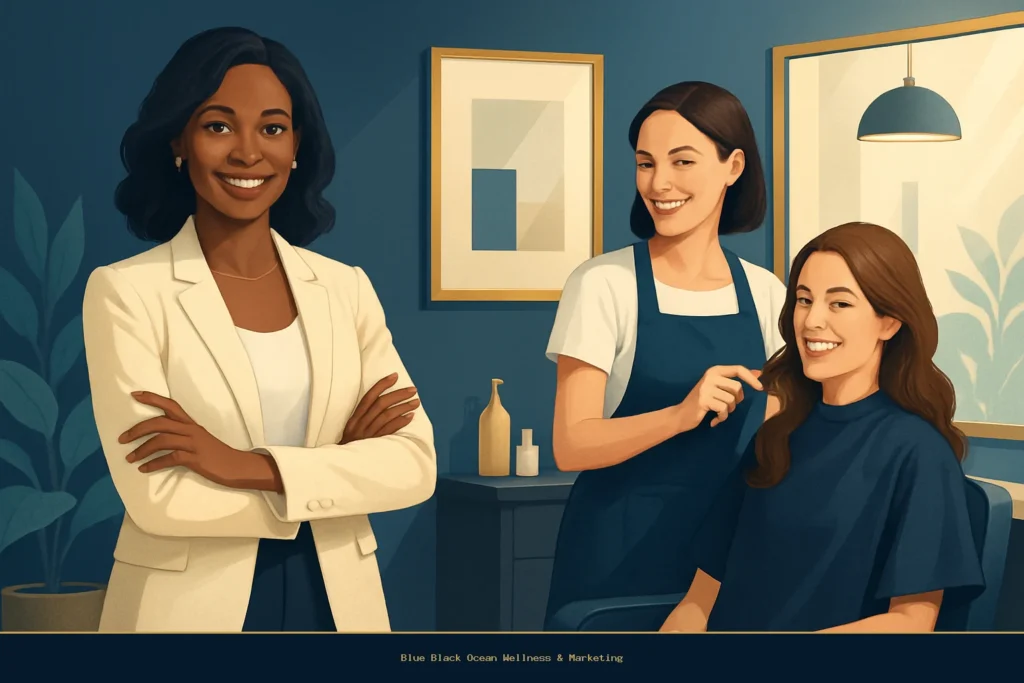
A client sits in the chair for the final blow-dry, catches her reflection, and says, “I love this.” She pays, tips well, and walks out the door. Six weeks later she is sitting in a different chair, at a different salon, because nobody asked her to come back to yours, and even if someone did, nothing followed up to remind her when the time came. That single moment, the walkout without a scheduled next visit, is where most salons quietly lose their weekday revenue.
Table of Contents
- The Uncomfortable Truth
- Why the Ask at the Chair Isn’t Enough
- What a Layered Rebooking System Actually Looks Like
- Key Takeaways
- A Composite Industry Scenario
- How Blue Black Ocean Approaches This Problem
- Your Action Plan for This Week
- Measuring Progress Over Time
- Frequently Asked Questions
- Is this really a marketing problem, or is it a scheduling problem?
- Do I need expensive new software to fix this?
- How do I know if my stylists are actually asking clients to rebook?
- What if a client says no when asked to rebook at the chair?
- What to Do Next
If your Friday and Saturday columns are packed but Tuesday through Thursday looks thin every single month, the problem is rarely a lack of new clients discovering you on Instagram or Google. It is a rebooking system with a hole in it, and no amount of extra posting will patch that hole.
The Uncomfortable Truth
Most salons treat rebooking as a single, optional moment: the stylist asks, “Want to grab your next appointment?” at the chair, and whatever happens next is up to the client’s memory and motivation. That is not a system. That is a hope.
Here is the uncomfortable part: the client’s trust in your salon is highest in the ten minutes after the service, while she is still looking at the result in the mirror. That trust does not stay at its peak. It decays, day by day, as life happens, other errands take priority, and her feed fills up with other options. If you do not convert that peak-trust moment into a scheduled appointment plus a digital safety net, you are relying on her to remember your name, your stylist’s name, and the right timing, weeks from now, with zero prompts from you.
Marketing gets blamed when the appointment book looks thin, but marketing’s job is discovery. Discovery was never the failure here. The failure happened at checkout, when a happy client left without a date on the calendar, and no automated message ever caught her before she called someone else.
Why the Ask at the Chair Isn’t Enough
A verbal rebooking ask depends entirely on a busy stylist remembering to say it, in the right way, every single time, for every single client. In real salon operations, that breaks constantly:
- The stylist is running behind and skips the ask to get the next client in the chair.
- The client says “I’ll call you later,” which almost never happens once she is home.
- The front desk is checking someone else out and the booking conversation never gets a second chance.
- There is no reminder message scheduled for six weeks later, so even a well-intentioned client simply forgets.
Each of those is a separate point of failure. A real rebooking system does not depend on any single person remembering anything in the moment. It is engineered so the client gets caught even when the human step gets missed.
What a Layered Rebooking System Actually Looks Like
Instead of one fragile ask, think of rebooking as a sequence with several checkpoints, each one backing up the last:
- Standardize the in-chair ask with a specific date. “Should we lock in six weeks from today, the 14th, same time?” converts far more reliably than an open-ended “want to book your next visit?” because it removes the decision-making burden from the client.
- Make front-desk booking a required checkout step, not optional. If booking the next visit is treated the same as processing payment, it stops depending on how busy the front desk happens to be that day.
- Send an automated confirmation immediately, with a simple link to reschedule if the date does not work. This removes friction and reduces the chance a client cancels and disappears instead of moving the appointment.
- Trigger a reminder message timed to that client’s service interval. Color clients typically fall somewhere around the five to six week mark, cut clients more like six to eight weeks. A reminder sent at the right interval, not a generic monthly blast, is what actually lands.
- Build a “we noticed it’s been a while” follow-up for anyone who passed their expected rebooking window without an appointment on the books. This is the safety net that catches clients who slipped through steps one through four.
- Reuse in-chair content between visits. Short video or photo content from real services keeps the salon visible in a client’s feed, so when the reminder text arrives, it lands with someone who already feels familiar with your work, not a cold contact.
Key Takeaways
- A thin weekday book usually signals a rebooking leak, not a discovery problem.
- Client trust peaks right after the service and fades quickly if it is not captured immediately.
- A single verbal ask at the chair is not a system; it is one fragile step that fails often.
- Effective rebooking requires layered checkpoints: chair, checkout, confirmation, timed reminder, and a recovery follow-up.
- Content between visits (photos, short videos) supports the reminder message; it does not replace the booking process.
A Composite Industry Scenario
Consider a mid-size salon with six stylists, illustrative rather than a real, named case. Weekends were fully booked, so leadership assumed new client acquisition was the priority and increased ad spend. When they finally mapped the actual client journey, checkout by checkout, they found the real pattern: a large share of walkouts left without a scheduled next appointment, and there was no automated system in place to follow up with any of them. The weekday gap was not a marketing reach problem; it was a process gap between the chair and the calendar.
How Blue Black Ocean Approaches This Problem
Blue Black Ocean works as the implementation partner for salons dealing with this exact leak, not just another agency posting content on top of a broken system. The approach typically includes:
- Diagnosis: mapping the client journey from chair to checkout to follow-up to find exactly where the sequence breaks.
- Content that reuses real service moments: filming short in-salon video and photo content that doubles as social proof and as material for reminder campaigns, so clients recognize the salon before a reminder text ever arrives.
- Consistent posting cadence: keeping the salon visible between visits so follow-up messages reach a warm audience.
- Booking flow improvements: reviewing or rebuilding the website and booking experience so rescheduling takes seconds, not a phone tag session.
- Ongoing measurement: tracking the rebooking rate and follow-up response over time, rather than treating this as a one-time fix.
Your Action Plan for This Week
- What to do: Pull the last 60 days of checkout records and review a sample of 20 clients. Count how many left without a next appointment already on the calendar.
- Who owns it: The owner or the designated front-desk lead, since they have direct access to the booking system and checkout history.
- What you need: Access to the booking software’s client history or a simple checkout log if one is kept manually.
- What to review: That single number, out of 20 clients, becomes your baseline. It tells you how large the leak actually is before you invest in fixing it.
Measuring Progress Over Time
Once you have a baseline, the goal is not to chase a specific percentage improvement immediately; it is to watch the trend. Track the same 20-client sample monthly, note how many rebook before checkout, how many respond to a reminder message, and how many needed the “it’s been a while” follow-up to come back at all. Review this monthly at first, then quarterly once the system stabilizes, and treat any steady improvement in weekday utilization as the real signal, not vanity metrics like likes or follower counts.
Frequently Asked Questions
Is this really a marketing problem, or is it a scheduling problem?
It’s both, and that is exactly why it gets missed. Marketing brings people in the door; what happens between that visit and the next one determines whether they come back. Content and reminders work together, but neither one works alone.
Do I need expensive new software to fix this?
Not necessarily. Many booking platforms already include automated confirmation and reminder capabilities that go unused. The first step is auditing what your current system already offers before assuming you need to replace it.
How do I know if my stylists are actually asking clients to rebook?
Look at your checkout data rather than relying on stylists to self-report. If a meaningful share of clients leave without an appointment on the books, the ask either isn’t happening consistently or isn’t being backed up by a checkout requirement.
What if a client says no when asked to rebook at the chair?
That is exactly what the timed reminder and the “it’s been a while” follow-up are for. A “no” at checkout should not mean the client disappears from your process; it should trigger the next safety net instead.
What to Do Next
If your weekday chairs sit lighter than they should while your weekends stay full, the fix is rarely another marketing campaign aimed at strangers. It starts with your own checkout data and the sequence between the chair and the calendar. Pull that 20-client sample this week and take an honest look at what it tells you.
If you want a second set of eyes on where your rebooking sequence is breaking, Blue Black Ocean offers a Free Marketing Direction Review to walk through your current process, no guarantees attached, just a clear look at where the leak is and what a realistic next step looks like for your salon.
Trả lời nhanh: Salon tóc đông khách cuối tuần nhưng vắng giữa tuần thường không thiếu khách mới, mà đang mất khách cũ vì họ rời đi mà không đặt lịch lần sau. Đây là lỗi quy trình giữa lúc làm tóc, quầy lễ tân, phần mềm đặt lịch và tin nhắn nhắc hẹn, không phải lỗi do đăng bài mạng xã hội ít.
Mục lục
Chủ salon nào cũng từng thấy cảnh này: thứ Sáu, thứ Bảy kín ghế từ sáng đến tối, nhưng thứ Ba, thứ Tư ghế trống quá nửa. Trang mạng xã hội vẫn có người xem, có người thả tim. Vậy khách đi đâu?
Câu trả lời thường không nằm ở chỗ salon thiếu khách mới. Nó nằm ở chỗ rất nhiều khách cũ, những người từng làm tóc rất ưng ý, đã lặng lẽ không quay lại. Không phải vì họ ghét salon. Mà vì không ai nhắc họ đúng lúc, và bản thân họ cũng quên.
Sự thật cần nhìn thẳng
Khoảnh khắc khách hài lòng nhất với mái tóc mới chính là lúc họ đứng dậy khỏi ghế, soi gương, cười tươi. Đó là lúc niềm tin cao nhất. Nếu salon không biến khoảnh khắc đó thành một lịch hẹn cụ thể cho lần sau, niềm tin ấy sẽ phai dần theo từng ngày.
Nhiều salon vẫn coi việc mời khách đặt lịch tiếp theo là một câu hỏi xã giao ở cuối buổi: “Chị có muốn đặt lịch lần sau không?”. Đây là một câu hỏi mở, dễ bị từ chối, và phụ thuộc hoàn toàn vào việc thợ có nhớ hỏi hay không, quầy lễ tân có đang bận hay không.
Khi không có ai hỏi, không có tin nhắn nhắc, không có quy trình theo dõi, khách sẽ rơi vào khoảng trống. Vài tuần sau họ quên tên thợ, quên mình “đến hạn” làm tóc, và khi lướt mạng xã hội thấy một salon khác quảng cáo đúng lúc, họ đặt lịch ở đó.
Hậu quả kinh doanh rất cụ thể: lịch làm việc giữa tuần bấp bênh, thợ làm theo hoa hồng có thu nhập không ổn định, chủ salon phải chi thêm tiền quảng cáo để tìm khách mới trong khi khách cũ âm thầm rời đi. Và marketing lại bị đổ lỗi là “không hiệu quả”, trong khi vấn đề thật sự nằm ở khâu giữ khách và mời tái khám, không phải khâu tìm khách mới.
Những điểm chính cần ghi nhớ
- Khách rời salon mà không đặt lịch lần sau là điểm rò rỉ doanh thu lớn nhất, thường bị bỏ qua vì nhìn không “nghiêm trọng” như một đợt vắng khách đột ngột.
- Việc mời đặt lịch tái khám cần là một bước bắt buộc trong quy trình thanh toán, không phải một câu hỏi tùy hứng.
- Tin nhắn hoặc email nhắc hẹn cần được gửi đúng thời điểm theo chu kỳ dịch vụ, không phải gửi đại trà cùng một lúc cho mọi khách.
- Nội dung mạng xã hội quay tại salon giúp khách nhớ mặt thợ, nhớ không gian salon, khiến tin nhắn nhắc hẹn sau này “quen mặt” hơn thay vì bị xem như tin rác.
- Đăng bài đều đặn không tự động giải quyết vấn đề tái khám nếu không kết nối với hệ thống đặt lịch và theo dõi khách.
Quy trình tái khám nên có tại salon
- Gợi ý ngày cụ thể tại ghế: Thay vì hỏi “chị có muốn đặt lịch không”, thợ nên nói “5 tuần nữa em thấy màu tóc chị sẽ cần làm mới, để em đặt lịch trước cho chị luôn nhé”. Câu hỏi có ngày cụ thể dễ được đồng ý hơn câu hỏi mở.
- Quầy lễ tân xác nhận trước khi khách rời đi: Việc đặt lịch lần sau nên là bước bắt buộc trong quy trình thanh toán, không phải bước “nếu khách muốn thì hỏi thêm”.
- Gửi xác nhận tự động ngay lập tức: Một tin nhắn hoặc email xác nhận lịch hẹn, kèm đường dẫn để đổi lịch dễ dàng nếu khách bận, giúp giảm tình trạng khách đặt lịch nhưng không đến.
- Nhắc hẹn đúng thời điểm: Khách nhuộm tóc thường cần quay lại sau khoảng 5-6 tuần, khách cắt tóc thường sau 6-8 tuần. Tin nhắn nhắc nên gửi đúng khoảng này, không phải gửi hàng loạt cùng một ngày cho mọi khách.
- Theo dõi khách quá hạn: Với những khách đã qua thời điểm dự kiến quay lại mà chưa có lịch hẹn mới, cần có một tin nhắn ngắn kiểu “đã lâu rồi không gặp chị, salon có suất trống tuần này” để chủ động kéo họ về.
- Tái sử dụng nội dung quay tại salon: Video ngắn về quá trình làm tóc, hình ảnh trước sau, giúp salon xuất hiện tự nhiên trong newsfeed của khách giữa các lần ghé thăm, khiến tin nhắn nhắc hẹn không bị xem như quảng cáo lạ.
Trước đây, salon muốn khách nhớ đến mình chủ yếu dựa vào tờ rơi phát ở khu dân cư, danh thiếp để lại, hoặc quảng cáo trên báo địa phương. Những kênh này khó đo lường và khó nhắm đúng nhóm khách. Mạng xã hội ngày nay cho phép salon tiếp cận đúng người từng làm tóc ở đó, thử nhiều kiểu nội dung khác nhau, và theo dõi ai đang tương tác. Nhưng công cụ dễ tiếp cận hơn không có nghĩa là kết quả tự đến. Nếu chiến lược nội dung, quảng cáo, website và quy trình theo dõi khách không được kết nối với nhau, salon vẫn đăng bài đều mà chair vẫn trống giữa tuần.
Ví dụ minh họa
Đây là một tình huống tổng hợp, không phải khách hàng thật, chỉ để minh họa cách vấn đề thường xảy ra. Một salon có 6 thợ, ghế luôn kín vào thứ Sáu và thứ Bảy nhưng thưa thớt từ thứ Ba đến thứ Năm. Ban đầu chủ salon nghĩ vấn đề là thiếu khách mới nên tăng ngân sách quảng cáo tìm khách. Sau khi rà lại quy trình từ lúc khách ngồi vào ghế đến lúc thanh toán, họ phát hiện phần lớn khách rời đi mà không có lịch hẹn tiếp theo, và salon không có bất kỳ tin nhắn hay quy trình nào để nhắc họ quay lại đúng thời điểm.
Giải pháp Blue Black Ocean đề xuất
Blue Black Ocean bắt đầu bằng việc chẩn đoán chính xác điểm nghẽn: vấn đề nằm ở lúc thợ chưa hỏi đặt lịch, lúc lễ tân bỏ sót bước xác nhận, hay lúc không có tin nhắn nhắc hẹn đúng thời điểm. Mỗi salon có một điểm rò rỉ khác nhau, và việc chẩn đoán đúng chỗ quan trọng hơn việc áp dụng một giải pháp chung chung.
Sau khi xác định điểm nghẽn, Blue Black Ocean có thể quay video ngắn ngay tại salon, ghi lại quy trình làm tóc, không gian, gương mặt thợ, để dùng làm nội dung nhắc nhớ khách giữa các lần ghé thăm. Nội dung này được đăng đều đặn lên fanpage, giúp khách quen mặt salon trước khi họ nhận được tin nhắn mời đặt lịch, thay vì cảm thấy đó là tin nhắn lạ.
Blue Black Ocean cũng hỗ trợ xây dựng hoặc cải thiện website salon, đảm bảo khách vào xem có thể hiểu rõ dịch vụ, giá tham khảo, phong cách của từng thợ, và đặt lịch trực tiếp mà không phải gọi điện hỏi lại nhiều lần. Mục tiêu là để khách hiểu salon trước khi họ bước vào cửa, đặt lịch, hoặc nhắn tin liên hệ, giảm bớt phần việc phải giải thích lặp lại cho quầy lễ tân.
Nếu salon của bạn đang gặp đúng tình huống ghế trống giữa tuần dù cuối tuần luôn kín lịch, hãy đặt một buổi tư vấn miễn phí về định hướng marketing (Free Marketing Direction Review) với Blue Black Ocean qua trang Contact. Buổi tư vấn không cam kết kết quả cụ thể, nhưng sẽ giúp bạn nhìn rõ điểm nghẽn thật sự đang nằm ở đâu trong quy trình giữ khách của salon.
Câu hỏi thường gặp
Làm sao biết salon của mình có đang mất khách vì không đặt lịch tái khám hay không?
Cách đơn giản nhất là lấy ra khoảng 20-30 hồ sơ khách thanh toán gần đây và đếm xem bao nhiêu người rời đi mà không có lịch hẹn kế tiếp được ghi lại. Nếu con số này cao, đó là dấu hiệu rõ ràng cần xử lý quy trình tái khám trước khi nghĩ đến việc tìm khách mới.
Có nên bắt buộc thợ phải hỏi đặt lịch với mọi khách không?
Nên biến việc gợi ý ngày cụ thể thành một phần tự nhiên của buổi làm tóc, thay vì một câu hỏi gượng ép ở cuối. Khi thợ nói rõ “khoảng bao lâu nữa nên quay lại” thay vì hỏi chung chung, khách dễ đồng ý đặt lịch hơn.
Đăng bài mạng xã hội đều đặn có giúp khách quay lại không?
Đăng bài đều đặn giúp khách nhớ đến salon, nhưng bản thân nó không thay thế được việc mời đặt lịch tại ghế và tin nhắn nhắc hẹn đúng thời điểm. Nội dung mạng xã hội có tác dụng tốt nhất khi được kết hợp với một quy trình theo dõi khách rõ ràng phía sau.
Khách đặt lịch nhưng không đến có liên quan đến vấn đề này không?
Có liên quan một phần. Khi salon gửi xác nhận lịch hẹn kèm đường dẫn đổi lịch dễ dàng, tình trạng khách đặt lịch nhưng không đến thường giảm, vì khách có thể chủ động dời lịch thay vì im lặng bỏ hẹn.


[…] Why Your Salon’s Weekdays Stay Empty While Weekends Sell Out […]
[…] Why Your Salon’s Weekdays Stay Empty While Weekends Sell Out […]