
Why Your Auto Repair Shop Is Losing Customers to Silence, Not Bad RepairsVì Sao Khách Sửa Xe Mất Niềm Tin Ngay Khi Xe Đang Nằm Trong Xưởng Của Bạn

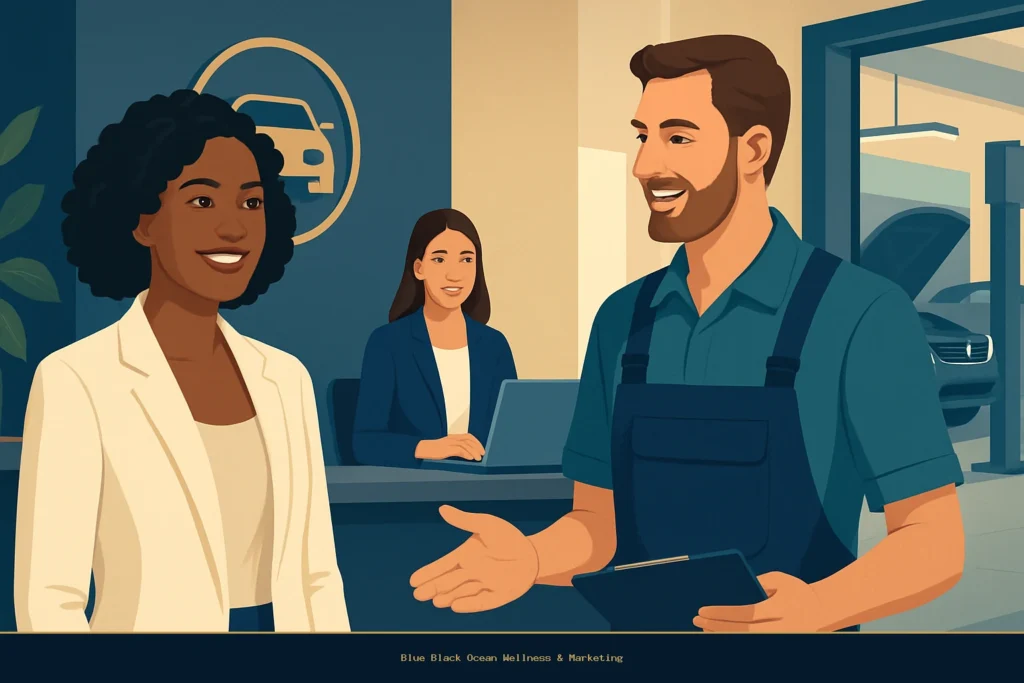
It is Wednesday afternoon. A customer dropped their car off Monday morning for a check engine light. They have already called the shop twice, spoken to two different people, and gotten two answers that did not quite match. No one called them first. Now they are sitting at their desk, phone in hand, quietly typing “second opinion auto repair near me” into Google, not because they think the diagnosis is wrong, but because the silence made them assume something is being hidden.
Table of Contents
- The Uncomfortable Truth
- Why the Whiteboard and “Whoever Answers the Phone” System Breaks Down
- The Fix Is a Checkpoint System, Not More Staff or More Ads
- Assigning a Single Point of Contact Per Vehicle
- A Practical Weekly Checklist for Owners
- An Illustrative Scenario: The One-Advisor Bottleneck
- Key Takeaways
- How Blue Black Ocean Approaches This Problem
- Action Plan: What to Do This Week
- Measuring Whether the System Is Working
- Frequently Asked Questions
- Why do customers leave negative reviews even when the repair was done correctly?
- Do we need new software to fix this, or can we use what we already have?
- How does this connect to our marketing and advertising, since it feels like an internal operations issue?
- Should the service advisor be the one making every update call personally?
- What if we start this system and it still feels inconsistent after a few weeks?
- Where to Go From Here
The mechanical work in that shop’s bay might be flawless. The estimate might be fair. But none of that matters yet, because the customer’s entire experience of the repair, so far, has been built entirely on guesswork and inconsistent phone calls. That is the moment where trust is won or lost, and it happens before a single wrench is even mentioned to the customer directly.
This is not a marketing problem in the traditional sense. It is a communication systems problem, and it is quietly canceling out the value of every five-star review, every Google ad, and every referral an auto repair shop has worked hard to earn.
The Uncomfortable Truth
Here is the uncomfortable truth: most shops do not lose repeat customers or referrals because of bad repairs. They lose them because of unmanaged silence. A customer does not leave a one-star review that says “the diagnosis was wrong.” They leave a review that says “poor communication,” “had to call three times,” or “felt like they forgot about my car.” The actual wrench work was often done correctly and priced fairly. The damage came from two or three days of not knowing what was happening.
The deeper truth is that this is not really a staffing problem or a “we need friendlier employees” problem. It is a structural gap. Most independent and small-chain shops have never defined, in writing, who owns the customer update once a vehicle is on the lift. The service advisor assumes the tech will mention it. The tech assumes the front counter will call. The front counter person, three cars behind on paperwork, assumes someone already called. Nobody actually did. This is not a people failure, it is a missing system.
And here is the part that makes it expensive: marketing generates the call. A Google Business Profile listing, a Facebook post, a search ad for “check engine light diagnostic near me,” or a friend’s referral gets the phone to ring. But the second that customer’s car is on the lift, marketing’s job is technically done, and operations takes over with no handoff plan. If operations drops the ball on communication, the lead that marketing worked to generate turns into a lost customer and, worse, a negative review that makes the next ad dollar less effective. Marketing and operations are not separate problems here. They are one connected system, and right now, for most shops, the connection is missing.
Why the Whiteboard and “Whoever Answers the Phone” System Breaks Down
Walk into almost any busy independent shop and you will find some version of a whiteboard, a paper ticket system, or a shared shop management tool that tracks which bay a car is in and what stage of repair it is at. That part usually works fine for the mechanics. What it almost never tracks is the last time someone told the customer anything, and who is responsible for telling them next.
So when a customer calls at 2pm on day two, whoever picks up the phone has to reconstruct the story from memory, a whiteboard note, or a guess. If that person is not the one who actually spoke to the tech that morning, the answer the customer gets is either vague (“we’re still looking at it”) or, worse, inconsistent with what a different staff member told them the day before. To the customer, inconsistency reads as either incompetence or dishonesty. Neither is true, but perception is what drives the phone call to the next shop.
This pattern repeats at scale across the industry because the root cause is structural, not personal. There is no shared, always-current log of “last update given” attached to each vehicle. There is no single named owner of that communication. And there is no minimum communication cadence, meaning updates only happen when someone remembers, not on a schedule the customer can count on.
The Fix Is a Checkpoint System, Not More Staff or More Ads
The solution here is not hiring a full-time receptionist, and it is not running more Google Ads to replace the customers who leave. The fix is building one simple, repeatable communication checkpoint system that any staff member can follow, tied to whatever tools the shop already uses (a shared spreadsheet, a basic CRM, shop management software, or even a disciplined group text log).
The system has three checkpoints:
- Checkpoint one, the diagnosis call or text. Within 30 to 60 minutes of the technician finishing the initial diagnosis, the customer gets a call or text with a plain-language explanation, an estimate range, and the next step. This single call prevents almost all of the “did you forget about my car” anxiety that builds in the first few hours.
- Checkpoint two, the midday holding update. If the repair spans more than one day, the customer gets a proactive update by midday, even if the update is nothing more than “still working on it, expect news by 4pm.” This is the checkpoint almost every shop skips, and it is the one that prevents the customer from calling first out of anxiety.
- Checkpoint three, the ready-for-pickup message. When the vehicle is done, the customer gets a plain-language summary of exactly what was done, not just “it’s ready.” This closes the loop and gives the customer language they can repeat to a friend when asked, “so what was actually wrong with it?”
None of these checkpoints require new software or a big budget. They require a decision about ownership and a shared place to log what was said and when.
Assigning a Single Point of Contact Per Vehicle
The single biggest fix inside this system is naming one person, typically the service advisor, as the owner of communication for each vehicle, rather than leaving it to “whoever answers the phone.” This does not mean that person has to personally make every call. It means every other staff member knows who owns it, and if that person is busy or out, anyone can check the shared log to see the last update given and continue the conversation accurately instead of guessing.
A Practical Weekly Checklist for Owners
Here is a straightforward way to put this into practice without disrupting the shop floor:
- Name the owner. Pick one role, usually the service advisor, as the default communication owner for every vehicle. Write it down. Post it where staff can see it.
- Create one shared tracking view. This can be a column added to existing shop management software, a shared spreadsheet, or a simple structured group text with a consistent format (“Smith, Silverado, diagnosed 10am, quoted $420, called customer 10:20am”). The goal is that any employee can glance at it and know the last update given.
- Set the three checkpoints as a minimum standard. Diagnosis call within an hour, midday update if the job runs past one day, ready-for-pickup summary. Treat these as non-negotiable, the same way an oil change interval is non-negotiable.
- Review missed-contact patterns weekly. At the end of each week, look at any vehicle that sat more than four hours without a logged customer update. Ask why. Usually the answer points to a specific bottleneck (short-staffed mornings, one advisor covering two roles) that can be addressed directly.
- Turn common explanations into short content. If the advisor is already explaining “what a check engine code means” or “why a diagnostic takes a few hours” verbally to customers all week, that same plain-language explanation can become a short video or post for the shop’s Google Business Profile or Facebook page, building trust with the next customer before they even call.
An Illustrative Scenario: The One-Advisor Bottleneck
Consider a composite, illustrative scenario, not a real client or a measured case study, that many small family-owned shops will recognize. A small shop takes in several vehicles a day but has only one service advisor, who also answers the phone, greets walk-ins, and processes payments. On a busy day, three or four cars go up on lifts by mid-morning. The advisor intends to call each customer once a diagnosis is ready, but between phone interruptions and walk-in customers at the counter, the calls slip to “later.” By early afternoon, customers who have not heard anything start calling in themselves, and whoever is free at that moment (a technician, a part-time counter person, someone unfamiliar with that specific vehicle’s status) answers with whatever partial information they have. Each customer gets a slightly different version of “still working on it.” None of the technical work is wrong. But by pickup, at least one customer has already started looking at other shops online, assuming that if the shop cannot manage a phone call, it might not be managing the repair carefully either.
This scenario illustrates the mechanism, not a specific outcome. The point is not that this exact story happened to a specific business. The point is that the structural gap, one person wearing too many hats with no shared tracking system, is common enough that most shop owners will recognize it immediately.
Key Takeaways
- Negative reviews about “communication” or “trust” often have nothing to do with the quality of the repair. They are a symptom of unmanaged silence during the repair window.
- The root cause is structural: no single named owner of customer updates, and no shared system for tracking what has already been communicated.
- A three-checkpoint system (diagnosis call, midday update, ready-for-pickup summary) closes the communication gap without requiring new staff or new software.
- Marketing generates the lead, but operations determines whether that lead becomes a repeat customer or a lost one. The two must be treated as one connected system.
- The same plain-language explanations used on the phone with customers can be repurposed into short educational content that builds trust before the phone even rings.
How Blue Black Ocean Approaches This Problem
Blue Black Ocean does not build a shop’s internal communication process. That is an operational decision that belongs to the owner and the service advisor, because it depends on staffing, shop layout, and daily workflow that only the people on the floor fully understand. What Blue Black Ocean does build is the marketing and content layer that reinforces trust before, during, and after that internal process.
In practice, that starts with diagnosis: reviewing a shop’s existing Google reviews and missed-call patterns to identify where communication gaps are already showing up in customer language, since customers almost always describe this problem in their own words even when they do not use the word “communication” directly. From there, Blue Black Ocean helps translate what the shop is already doing well, like an advisor’s habit of explaining a diagnostic in plain terms, into short, on-site videos and posts that give prospective customers real proof of transparency before they ever call. That includes maintaining a consistent posting cadence on the shop’s Google Business Profile and Facebook page, and building or improving a website so that a customer researching “why is my check engine light on” or comparing repair estimates finds clear, credible information first, rather than landing on a generic page that tells them nothing.
The goal is not to promise more reviews, more leads, or better rankings, because those outcomes depend on many factors outside any single vendor’s control. The goal is to make sure that every marketing dollar a shop spends is supported by a customer experience that reinforces, rather than undermines, the trust that marketing worked to create.
Action Plan: What to Do This Week
This does not require a new system, a new hire, or a new budget line. It requires one decision and one habit, starting this week:
- What to do: Assign one person as the designated status-update owner for every vehicle currently in the shop.
- Who owns it: The owner or shop manager makes this assignment, typically the service advisor, and communicates it clearly to the whole team.
- What tool is needed: Whatever the shop already has, a shared spreadsheet, a column in existing shop management software, or a structured group text log, as long as it is visible to more than one person.
- What signal to review: By end of day, every vehicle that has been in the shop more than four hours without customer contact should have received one proactive text or call. At the end of the week, review how many vehicles missed that window and why.
Measuring Whether the System Is Working
Because this is an operational and communication fix, the measurement plan should track behavior and perception, not invented statistics. Start with a simple baseline: how many vehicles currently sit longer than four hours without a logged customer update, and what do recent reviews say about communication versus repair quality. Then, using check-in points roughly one week and four weeks after implementation, review three signals: whether the proactive-update habit is actually happening consistently across staff, whether repeat customers or callers mention noticing the change, and whether new reviews shift in language, from vague complaints about “never got a call back” toward specific mentions of being kept informed. These are leading indicators, not guarantees, and they should be reviewed honestly rather than assumed.
Frequently Asked Questions
Why do customers leave negative reviews even when the repair was done correctly?
Because the review reflects the customer’s overall experience, not just the mechanical outcome. If a customer spent two days calling repeatedly and getting inconsistent answers, that anxiety and frustration becomes the headline of their review, even if the actual repair was accurate and fairly priced. Customers rarely have the technical knowledge to evaluate the repair itself, but they always have direct knowledge of how they were treated and informed.
Do we need new software to fix this, or can we use what we already have?
In most cases, no new software is required. The fix is behavioral and structural: naming one communication owner per vehicle and setting a minimum update cadence. A shared spreadsheet, an existing column in shop management software, or a disciplined group text log is usually enough, as long as it is visible to more than one staff member so coverage does not break down when the primary contact is busy or out.
How does this connect to our marketing and advertising, since it feels like an internal operations issue?
Marketing and advertising generate the phone call or the estimate request. What happens after that call determines whether the marketing spend produces a repeat customer and a positive review, or a lost customer and a negative one. If the communication gap is not addressed, every dollar spent on ads, a Google Business Profile, or referral marketing is working against an operational leak that quietly cancels out the return on that spend.
Should the service advisor be the one making every update call personally?
Not necessarily. The advisor should be the named owner of communication for each vehicle so there is no ambiguity about responsibility, but the actual call or text can be handled by whoever is available, as long as they check the shared log first to see what was already communicated. The goal is consistency of information, not requiring one person to do every task personally.
What if we start this system and it still feels inconsistent after a few weeks?
That usually points to either understaffing at a specific time of day (often mid-morning, when diagnoses are completing but the front counter is also handling walk-ins) or a tracking tool that is not actually visible to everyone. Reviewing the weekly missed-contact pattern, as outlined in the checklist, usually reveals exactly where the bottleneck is so it can be addressed directly rather than guessed at.
Where to Go From Here
A shop’s mechanical reputation and its communication reputation are two different things, and right now, for most independent shops, only one of them is being actively managed. Fixing the communication gap does not require new advertising spend or a bigger team. It requires naming one owner, setting a simple three-checkpoint standard, and making sure marketing and operations are finally working from the same set of expectations about what a customer experiences between drop-off and pickup.
If you want an outside perspective on where your shop’s communication gaps are already showing up in reviews, missed calls, or stalled estimate requests, and how your Google Business Profile, website, and social presence could be reinforcing trust instead of leaving that job entirely to whoever answers the phone, Blue Black Ocean offers a Free Marketing Direction Review. There is no guarantee of specific results attached to that conversation, only a clear, honest look at where the gap is and what a realistic next step looks like for your shop.
Trả lời nhanh: Khách sửa xe mất niềm tin không phải vì tay nghề kém, mà vì trong lúc xe nằm ở xưởng, không ai chủ động báo tình trạng, khiến khách phải tự gọi nhiều lần và nhận câu trả lời khác nhau. Giải pháp là xây dựng quy trình cập nhật rõ ràng, có người phụ trách cố định, không phụ thuộc vào việc quảng cáo nhiều hơn.
Mục lục
- Sự thật cần nhìn thẳng
- Nguyên nhân gốc nằm ở đâu
- Những điểm chính cần ghi nhớ
- Quy trình ba mốc cập nhật thực tế
- Ai nên là người phụ trách
- Ví dụ minh họa để dễ hình dung
- Quảng cáo đã thay đổi, nhưng vấn đề vận hành thì không tự biến mất
- Giải pháp Blue Black Ocean đề xuất
- Câu hỏi thường gặp
- Cần bao lâu để thấy thay đổi rõ ràng khi áp dụng quy trình cập nhật ba mốc?
- Nếu tiệm chỉ có một hoặc hai nhân viên, có áp dụng được quy trình này không?
- Marketing có giúp giải quyết được vấn đề giao tiếp trong lúc sửa xe không?
- Có cần phần mềm quản lý khách hàng phức tạp để áp dụng quy trình này không?
Xe vào xưởng thứ Hai vì đèn báo lỗi động cơ. Đến chiều thứ Tư, khách đã gọi hai lần, mỗi lần nói chuyện với một người khác nhau, mỗi người nói một kiểu. Không ai chủ động gọi lại. Khách bắt đầu lên mạng tìm tiệm khác để hỏi ý kiến thứ hai, không phải vì nghi ngờ tay nghề, mà vì sự im lặng khiến họ nghĩ tiệm đang giấu điều gì đó hoặc đã quên mất chiếc xe của mình.
Đây là tình huống lặp lại ở rất nhiều tiệm sửa xe nhỏ và vừa tại Mỹ. Vấn đề không nằm ở chuyên môn kỹ thuật. Vấn đề nằm ở khoảng trống giao tiếp trong lúc xe đang được sửa, khoảng thời gian mà khách hàng cảm thấy mất kiểm soát nhất.
Sự thật cần nhìn thẳng
Rất nhiều chủ tiệm nghĩ rằng nếu sửa xe tốt, giá hợp lý, khách sẽ quay lại và giới thiệu bạn bè. Điều đó đúng một phần, nhưng chưa đủ. Trải nghiệm của khách không chỉ được đánh giá bằng kết quả cuối cùng, mà bằng cảm giác trong suốt quá trình chờ đợi.
Một chiếc xe nằm trong xưởng hai đến ba ngày mà không có cập nhật nào sẽ khiến khách tự suy diễn. Họ không biết xưởng đang bận, đang chờ phụ tùng, hay đang gặp khó khăn kỹ thuật. Họ chỉ biết là không ai gọi cho họ. Sự im lặng đó, dù vô tình, lại được khách hiểu là thiếu minh bạch.
Hậu quả không dừng ở một khách hàng khó chịu. Khách đó thường để lại đánh giá tiêu cực, không phải về chất lượng sửa chữa, mà về “giao tiếp kém” hoặc “không thể tin tưởng”. Đánh giá này xuất hiện trên Google, ảnh hưởng đến những khách hàng tiềm năng đang tìm tiệm sửa xe gần nhà và đang phân vân giữa vài lựa chọn.
Đồng thời, những khách hàng mới gọi đến hỏi báo giá từ quảng cáo hoặc từ hồ sơ doanh nghiệp trên Google cũng gặp tình trạng tương tự. Họ gọi hỏi tiến độ báo giá, nhận câu trả lời chậm hoặc không nhất quán, rồi âm thầm chuyển sang gọi tiệm khác. Tiệm mất khách không phải vì đối thủ giỏi hơn, mà vì quy trình phản hồi nội bộ chưa được thiết lập rõ ràng.
Nguyên nhân gốc nằm ở đâu
Phần lớn các tiệm sửa xe độc lập hoặc chuỗi nhỏ không có quy định về thời gian phản hồi và không phân công rõ ai chịu trách nhiệm cập nhật khách hàng khi xe đang được sửa. Cố vấn dịch vụ, thợ máy, và người trực điện thoại đều ngầm cho rằng người khác sẽ gọi lại cho khách.
Không có hệ thống ghi chú chung, không có phần mềm quản lý khách hàng, không có mẫu tin nhắn cập nhật. Mọi cuộc gọi đến và mọi câu trả lời đi ra phụ thuộc hoàn toàn vào việc ai đang trực điện thoại lúc đó và người đó nhớ được gì từ bảng trắng hoặc lời dặn miệng của đồng nghiệp.
Marketing, dù là quảng cáo, hồ sơ Google, hay bài đăng mạng xã hội, chỉ có nhiệm vụ tạo ra cuộc gọi đầu tiên hoặc lượt khách hàng tiềm năng. Nhưng nếu không có quy trình kết nối để quản lý trải nghiệm của khách từ lúc để xe đến lúc lấy xe, thì toàn bộ công sức marketing đó bị vô hiệu hóa bởi một lỗ hổng vận hành mà marketing đơn thuần không thể sửa được.
Những điểm chính cần ghi nhớ
- Khách mất niềm tin chủ yếu vì thiếu cập nhật, không phải vì chất lượng sửa chữa kém.
- Đánh giá tiêu cực về “giao tiếp” thường xuất hiện ngay cả khi xe được sửa đúng và giá hợp lý.
- Nguyên nhân gốc là thiếu quy định về thời gian phản hồi và thiếu người phụ trách cố định cho từng xe.
- Marketing tạo ra khách hàng tiềm năng, nhưng không thể thay thế quy trình giao tiếp nội bộ trong lúc sửa xe.
- Giải pháp không phải là quảng cáo nhiều hơn, mà là xây dựng hệ thống cập nhật đơn giản, có thể lặp lại.
Quy trình ba mốc cập nhật thực tế
Thay vì cố gắng gọi điện liên tục hoặc để mặc cho khách tự hỏi, tiệm có thể áp dụng một quy trình đơn giản với ba mốc cập nhật cố định. Quy trình này không đòi hỏi phần mềm phức tạp, chỉ cần một người chịu trách nhiệm và một cách ghi chú nhất quán.
- Xác nhận sau chẩn đoán (trong vòng 30 đến 60 phút): Ngay khi thợ máy xác định được vấn đề, cố vấn dịch vụ gọi hoặc nhắn tin cho khách với khoảng giá ước tính và bước tiếp theo. Đây là lúc khách cần biết rõ nhất, vì đây là thời điểm họ quyết định có đồng ý sửa hay không.
- Cập nhật giữa chừng nếu việc sửa kéo dài hơn một ngày: Ngay cả khi chưa có gì mới, một tin nhắn ngắn như “xe vẫn đang được xử lý, dự kiến có kết quả trước 4 giờ chiều” cũng đủ để khách yên tâm. Điều khách sợ nhất không phải là chờ lâu, mà là không biết mình đang chờ gì.
- Thông báo khi xe sẵn sàng: Kèm theo một đoạn giải thích ngắn gọn, dễ hiểu về những gì đã được sửa. Tránh dùng thuật ngữ kỹ thuật khó hiểu. Khách cần cảm thấy họ hiểu được số tiền mình vừa trả cho việc gì.
Ai nên là người phụ trách
Cách hiệu quả nhất là chỉ định một cố vấn dịch vụ cụ thể làm đầu mối liên lạc cho mỗi chiếc xe, thay vì để “ai nghe máy thì trả lời”. Nếu người đó bận, cần có một bảng theo dõi chung, có thể chỉ là một tờ giấy ghi chú dùng chung, một bảng tính đơn giản, hoặc một nhóm tin nhắn nội bộ, để bất kỳ nhân viên nào cũng có thể xem được lần cập nhật gần nhất đã nói gì với khách.
Điều quan trọng không phải là công nghệ phức tạp. Điều quan trọng là tính nhất quán. Khách hàng không cần một hệ thống hoàn hảo, họ chỉ cần cảm giác rằng có người đang theo dõi xe của họ và sẽ báo lại đúng hẹn.
Ví dụ minh họa để dễ hình dung
Đây là tình huống tổng hợp dùng để minh họa, không phải case study thật của khách hàng cụ thể nào.
Một tiệm sửa xe gia đình quy mô nhỏ, tiếp nhận nhiều xe mỗi ngày nhưng chỉ có một cố vấn dịch vụ kiêm luôn việc trực điện thoại. Vào những ngày đông khách, xe được đưa vào sửa nhưng không ai chủ động gọi lại cho khách. Khách phải tự gọi hỏi nhiều lần trong ngày, và mỗi lần nhận được một câu trả lời khác nhau tùy vào ai đang nghe máy lúc đó.
Nếu tiệm này áp dụng quy trình ba mốc cập nhật ở trên, với một người cụ thể chịu trách nhiệm và một bảng ghi chú chung, khách sẽ không cần gọi lại nhiều lần nữa. Sự thay đổi quan sát được không phải là doanh thu tăng ngay lập tức, mà là số lượng cuộc gọi hỏi tiến độ giảm xuống, và cách khách hàng phản hồi trong các cuộc trò chuyện trở nên nhẹ nhàng, tin tưởng hơn.
Quảng cáo đã thay đổi, nhưng vấn đề vận hành thì không tự biến mất
Trước đây, tiệm sửa xe muốn tiếp cận khách mới thường phải in tờ rơi, gửi thư trực tiếp, đăng báo địa phương, hoặc thuê bảng quảng cáo ngoài đường. Những kênh này tốn kém và khó đo lường hiệu quả thực sự.
Ngày nay, mạng xã hội và hồ sơ doanh nghiệp trên Google giúp tiệm sửa xe tiếp cận đúng nhóm khách hàng ở gần khu vực, thử nghiệm các cách giải thích dịch vụ khác nhau, và theo dõi phản hồi với chi phí linh hoạt hơn nhiều so với trước. Nhưng điều đó không có nghĩa là social media luôn rẻ hơn hoặc luôn hiệu quả hơn trong mọi trường hợp.
Vấn đề thực sự nằm ở chỗ: nhiều tiệm sửa xe đã có lượng khách gọi đến hoặc lượt xem trên mạng xã hội, nhưng chưa có chiến lược nội dung, cách nhắm đúng đối tượng, và quy trình theo dõi khách hàng sau khi họ gọi đến. Công cụ tiếp cận đã dễ dàng hơn, nhưng nếu chiến lược, nội dung, quảng cáo, website và quy trình chăm sóc khách hàng không được kết nối với nhau, thì lượng khách gọi đến vẫn sẽ rò rỉ ở khâu giao tiếp trong lúc sửa xe, đúng như tình huống đã nói ở trên.
Giải pháp Blue Black Ocean đề xuất
Blue Black Ocean không xây dựng quy trình vận hành nội bộ của xưởng, đó là quyết định thuộc về chủ tiệm và đội ngũ cố vấn dịch vụ. Nhưng Blue Black Ocean xây dựng lớp nội dung và marketing giúp củng cố niềm tin trước, trong, và sau quá trình sửa xe, để mọi nỗ lực vận hành của tiệm được khách hàng nhìn thấy và ghi nhận đúng cách.
Cụ thể, Blue Black Ocean có thể hỗ trợ:
- Chẩn đoán điểm nghẽn: Xem lại các đánh giá gần đây, mô hình cuộc gọi nhỡ, và phản hồi của khách để xác định chính xác giao tiếp đang bị đứt gãy ở đâu, trước khi đề xuất bất kỳ nội dung hay quảng cáo nào.
- Quay video tại xưởng: Ghi lại những đoạn video ngắn, dễ hiểu, giải thích các lỗi thường gặp như đèn báo động cơ nghĩa là gì, hoặc quy trình kiểm tra xe diễn ra như thế nào, giúp khách hàng hình dung được sự minh bạch trước cả khi họ gọi điện.
- Đăng nội dung fanpage đều đặn: Duy trì lịch đăng bài ổn định trên Facebook và Google Business Profile, cho khách thấy bằng chứng thực tế về cách tiệm làm việc, thay vì chỉ nói suông về chất lượng dịch vụ.
- Xây dựng hoặc cải thiện website: Đảm bảo khi khách tìm kiếm “vì sao đèn báo động cơ sáng” hoặc so sánh báo giá, họ tìm thấy thông tin rõ ràng, dễ hiểu, đáng tin cậy từ chính tiệm của bạn trước khi họ nhấc máy gọi.
- Giúp khách hiểu doanh nghiệp trước khi liên hệ: Kết nối nội dung, website, và hồ sơ doanh nghiệp thành một trải nghiệm nhất quán, để khách cảm thấy an tâm đặt lịch hoặc gọi hỏi báo giá ngay từ lần tiếp cận đầu tiên.
Nếu bạn muốn biết chính xác điểm nghẽn giao tiếp của tiệm mình đang nằm ở đâu, hãy đăng ký một buổi Free Marketing Direction Review với Blue Black Ocean. Đây không phải là buổi tư vấn cam kết kết quả, mà là buổi nhìn thẳng vào thực trạng hiện tại để xác định bước đi phù hợp tiếp theo. Bạn có thể liên hệ qua trang Contact để đặt lịch.
Câu hỏi thường gặp
Cần bao lâu để thấy thay đổi rõ ràng khi áp dụng quy trình cập nhật ba mốc?
Thời gian thay đổi tùy vào quy mô tiệm và số lượng xe xử lý mỗi ngày. Dấu hiệu quan sát được sớm nhất thường là số lượng cuộc gọi hỏi tiến độ từ khách giảm xuống, và cách khách phản hồi trong cuộc gọi trở nên bớt căng thẳng hơn. Đây là những tín hiệu quan sát được, không phải con số cam kết trước.
Nếu tiệm chỉ có một hoặc hai nhân viên, có áp dụng được quy trình này không?
Có. Quy trình ba mốc không đòi hỏi nhiều nhân sự, mà đòi hỏi tính nhất quán. Ngay cả khi chỉ có một người phụ trách, việc ghi chú lại nội dung đã trao đổi với từng khách trên một tờ giấy hoặc ứng dụng ghi chú đơn giản cũng đủ để duy trì sự minh bạch.
Marketing có giúp giải quyết được vấn đề giao tiếp trong lúc sửa xe không?
Marketing không thể thay thế quy trình nội bộ, nhưng marketing có thể củng cố niềm tin bằng cách giải thích trước cho khách hiểu cách tiệm làm việc, thông qua video, bài đăng, và website. Khi khách đã hiểu quy trình trước khi đến, họ sẽ bớt lo lắng hơn trong lúc chờ đợi.
Có cần phần mềm quản lý khách hàng phức tạp để áp dụng quy trình này không?
Không nhất thiết. Nhiều tiệm bắt đầu chỉ với một bảng tính chia sẻ hoặc một nhóm tin nhắn nội bộ. Phần mềm chuyên dụng có thể hữu ích khi tiệm phát triển lớn hơn, nhưng điều quan trọng nhất vẫn là có người chịu trách nhiệm và cập nhật đúng thời điểm.

[…] Why Your Auto Repair Shop Is Losing Customers to Silence, Not Bad Repairs […]