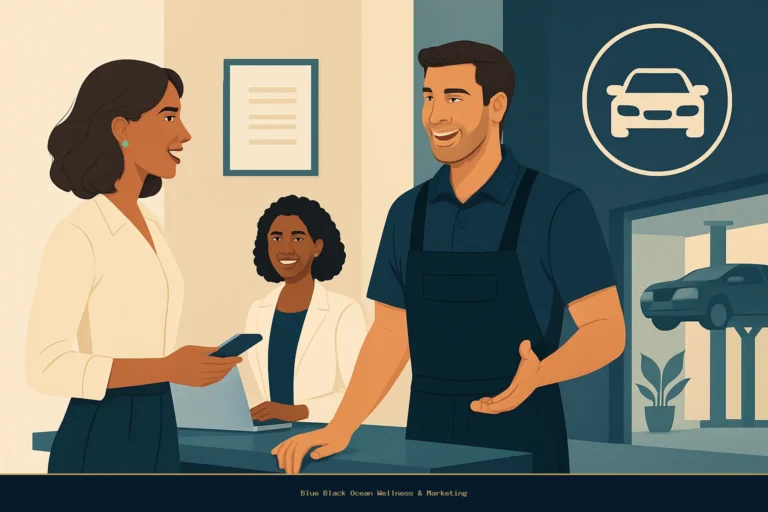
Why Your HVAC Website Loses Customers Before They Ever CallVì Sao Khách Đặt Lịch Sửa Điện Lạnh, Điện Nước Rồi Biến Mất Ngay Trên Website Của Bạn


It’s July, the AC just died, and the homeowner is sweating through a search on their phone. They land on your website. There’s a form labeled “Request a Quote.” No price range. No mention of how fast someone can show up. No phone number they can see without scrolling. They hesitate for a few seconds, close the tab, and call the next company on the results page instead, the one with a phone number in bold at the top and the words “same-day service” right under it.
Table of Contents
- The Uncomfortable Truth
- Why This Keeps Happening
- Key Takeaways
- A Composite Industry Scenario
- The Four-Point Conversion Audit
- Trust Signals That Actually Matter
- How Blue Black Ocean Approaches This Problem
- Your Action Plan for This Week
- Frequently Asked Questions
- Does showing pricing information scare customers away?
- Will a new website automatically increase booked jobs?
- What’s the fastest fix if I can only do one thing this week?
- How do I know if my current site has this problem?
- Next Step
That homeowner never became a lead. Not because your company couldn’t help them, and not because your ad or your SEO ranking failed. Your website lost the job in the ten seconds it had to earn trust.
This is the pattern behind a problem a lot of HVAC, plumbing, and electrical contractors don’t diagnose correctly: they assume they have a lead generation problem when they actually have a conversion path problem. The traffic is showing up. It’s dying on the page.
The Uncomfortable Truth
Most contractor websites are built to look credible, not to reduce the specific anxiety a customer feels in the moment they’re deciding whether to hand over their contact information for an urgent, expensive repair.
A person facing a possible $150 diagnostic fee, or a $6,000 system replacement, is not browsing casually. They are trying to answer four questions fast: roughly what will this cost, how soon can someone get here, is this a real licensed company or a fly-by-night operation, and what happens right after I submit this form. If your website doesn’t answer those questions before they have to ask, most people will not fill out the form to find out. They will leave and find a site that already told them.
This is why paid search budgets and SEO rankings can look strong while booked jobs stay flat. The traffic arrives. The website adds friction instead of removing it. Office staff then spend hours calling back leads who submitted a form during a moment of panic, got no immediate confirmation, panicked more, and called someone else in the meantime.
Why This Keeps Happening
Three habits show up repeatedly on home service websites:
- The phone number is an afterthought. It’s in the header in small text, or only in the footer, instead of sticky and visible on every mobile screen.
- The call to action is vague. “Contact Us” or “Request a Quote” doesn’t tell a stressed homeowner what will happen next, so they assume the worst: a slow callback, a sales pitch, or silence.
- Pricing is treated as a taboo topic. Contractors worry that mentioning cost will scare people off, so the site says nothing at all. Silence scares people off faster than an honest explanation of how pricing works.
None of this means you need to publish a rate card. It means the site needs to explain the logic: what a diagnostic visit typically covers, what’s included in a free estimate, and what kinds of factors affect the final number. That’s reassurance, not a quote.
Key Takeaways
- Estimate anxiety, not lack of traffic, is often the real reason forms go unanswered and calls never happen.
- Customers decide whether to trust a company within seconds, based on visible signals: phone number placement, arrival language, licensing proof, and pricing transparency.
- A confirmation message after form submission (text or on-screen) is one of the highest-leverage, lowest-cost fixes available.
- More ad spend cannot fix a conversion path that already loses the customer’s trust on the landing page.
A Composite Industry Scenario
Here’s an illustrative pattern, not a documented result from any specific client: a mid-size HVAC and plumbing company was running paid search campaigns and generating solid call volume. Their “Schedule Service” form, however, gave no confirmation after submission and included no explanation of pricing or scheduling logic. In this type of scenario, prospects have reported hesitating on the form because they had no idea whether someone would call back that day or sometime next week, so some left to call a competitor instead. This composite scenario is used only to illustrate the mechanism, not as a claimed client outcome.
The Four-Point Conversion Audit
Before touching design, color schemes, or copywriting, run this checklist on your own site exactly as a panicked customer would:
- Phone visibility: On a phone, can you find your number in under three seconds, on every page, without scrolling?
- Arrival transparency: Does the page state, above the fold, whether same-day or emergency service is available, and roughly when?
- Pricing logic: Is there a plain-language explanation of diagnostic fees, free estimate scope, and what typically affects cost, instead of a blank form with no context?
- Post-submission clarity: After someone fills out a form, do they immediately see or receive a message telling them exactly what happens next and when to expect a call?
Write down every point where you, the owner, hesitated or felt unsure. That hesitation is the same friction your customers feel, and it’s the first thing to fix.
Trust Signals That Actually Matter
- License and insurance information placed near the call to action, not buried on an “About Us” page.
- Real photos or short video of your trucks and technicians, not stock imagery.
- Consistent, active social content that shows the company is real, current, and responsive before the customer ever calls.
How Blue Black Ocean Approaches This Problem
Blue Black Ocean starts by diagnosing exactly where a website’s conversion path breaks: phone visibility, form clarity, trust signals, and what happens (or doesn’t) after someone submits a request. From there, the priorities are sequenced based on where the biggest hesitation points are, not on generic best practices.
Part of that work includes recording short, on-site video content showing real trucks, real technicians, and visible licensing proof, along with maintaining consistent social content that builds familiarity before a homeowner ever picks up the phone. The website itself gets rebuilt or adjusted so a visitor understands who the company is, how pricing logic works, and what the next step looks like, all before they have to ask. Progress gets measured against a clear baseline: current friction points identified this week, then reviewed again at defined intervals to see whether hesitation points have actually been removed.
Your Action Plan for This Week
- Owner or office manager: Open your website on a phone and try to book emergency service as if you were the panicked customer from the opening scenario.
- Time it: How long does it take to find your phone number, understand a general price range, and see what happens after the form is submitted?
- Document friction: Write down every moment of hesitation, confusion, or doubt, no matter how small.
- Review with your team: Bring that list to whoever manages your website or marketing and prioritize fixes by which friction point costs you the most calls.
Frequently Asked Questions
Does showing pricing information scare customers away?
Not when it’s framed as logic rather than a fixed number. Explaining what a diagnostic fee generally covers, or what factors influence a final estimate, reassures customers without locking you into a specific quote before you’ve seen the job.
Will a new website automatically increase booked jobs?
No website change guarantees a specific increase in leads or revenue. What a clearer conversion path can do is remove the friction that causes existing traffic, whether from ads, SEO, or referrals, to abandon the site instead of converting.
What’s the fastest fix if I can only do one thing this week?
Add a clear, sticky phone number visible on every mobile screen, and set up a confirmation message after form submission that tells the customer exactly when to expect a response. These two changes address the two biggest sources of silent drop-off.
How do I know if my current site has this problem?
Run the four-point audit above yourself, on a phone, timing your own hesitation. If you pause or feel unsure at any step, your customers are pausing there too.
Next Step
If reading through this checklist made you realize your own site would frustrate a panicked customer, that’s useful information, not a reason to panic yourself. Blue Black Ocean offers a Free Marketing Direction Review to walk through exactly where your website’s conversion path is losing trust, with no guarantees of rankings or lead volume attached, just a clear look at what’s happening between the click and the call.
Trả lời nhanh: Khách hàng dịch vụ điện lạnh, điện nước rời khỏi website mà không liên hệ chủ yếu vì ba điều chưa rõ ràng: không thấy số điện thoại dễ bấm, không hiểu giá cả sẽ tính thế nào, và không biết sau khi gửi form thì ai sẽ gọi lại, khi nào. Sửa đúng ba điểm này thường quan trọng hơn việc đổ thêm tiền quảng cáo.
Mục lục
Một khách hàng đang đứng trước bồn nước rò rỉ hoặc máy lạnh chết giữa trưa hè 38 độ. Họ không có thời gian để đọc kỹ, không có tâm trạng để “tìm hiểu thêm”. Họ cần biết ngay: công ty này có đến hôm nay không, giá khoảng bao nhiêu, và có đáng tin không. Nếu website không trả lời được ba điều đó trong vài giây, họ bấm quay lại kết quả tìm kiếm và gọi công ty tiếp theo.
Sự thật cần nhìn thẳng
Rất nhiều công ty điện lạnh, điện nước đầu tư mạnh vào quảng cáo, vào SEO, vào việc xuất hiện trên Google. Lưu lượng khách vào website không thiếu. Nhưng số lượng khách thực sự gọi điện hoặc điền form lại thấp hơn nhiều so với kỳ vọng. Vấn đề không nằm ở việc thiếu khách ghé thăm trang. Vấn đề nằm ở chính trang đó khiến khách chần chừ rồi rời đi.
Nguyên nhân gốc thường là website được thiết kế để trông chuyên nghiệp, nhưng không được thiết kế theo đúng tâm lý của người đang gặp sự cố khẩn cấp hoặc phải chi một khoản tiền lớn. Một form “Yêu cầu báo giá” trống trơn, không nói gì về mức phí kiểm tra ban đầu, không có số điện thoại hiện rõ trên điện thoại di động, không có xác nhận gì sau khi bấm gửi. Với một khách đang lo lắng, sự im lặng đó bị hiểu là rủi ro. Họ không muốn là người đầu tiên chờ đợi trong im lặng.
Những điểm chính cần ghi nhớ
- Khách gặp sự cố khẩn cấp quyết định trong vài giây, không phải vài phút. Website phải trả lời nhanh, không bắt khách phải tự tìm.
- Số điện thoại phải luôn hiện rõ trên màn hình điện thoại, ở mọi trang, không chỉ ở trang liên hệ.
- Khách không cần biết giá chính xác ngay, nhưng cần hiểu logic tính giá: phí kiểm tra ban đầu là bao nhiêu, điều gì ảnh hưởng đến chi phí cuối cùng.
- Sau khi gửi form, khách cần được xác nhận ngay, dù chỉ là một dòng chữ hoặc tin nhắn nói rõ khi nào sẽ có người liên hệ lại.
- Bằng chứng cấp phép, bảo hiểm và hình ảnh đội ngũ, xe tải thật giúp giảm cảm giác rủi ro khi khách chưa từng làm việc với công ty.
Quy trình kiểm tra website theo góc nhìn của khách đang gặp sự cố
- Bước 1, đóng vai khách hoảng loạn: Mở website bằng điện thoại, giả định bạn đang có sự cố cần xử lý trong hôm nay. Tính thời gian để tìm ra số điện thoại.
- Bước 2, kiểm tra thông tin giá: Xem website có giải thích phí kiểm tra ban đầu, phạm vi báo giá miễn phí, hoặc những yếu tố ảnh hưởng đến chi phí hay không.
- Bước 3, thử điền form: Điền form yêu cầu dịch vụ như một khách thật. Ghi lại xem có xác nhận nào xuất hiện ngay sau khi gửi không, và xác nhận đó có nói rõ bước tiếp theo hay không.
- Bước 4, tìm bằng chứng đáng tin: Kiểm tra xem có thông tin về giấy phép hành nghề, bảo hiểm, hoặc hình ảnh thật của đội thợ và xe công ty gần khu vực nút bấm liên hệ hay không.
- Bước 5, ghi lại từng điểm khiến bạn do dự: Mỗi lần bạn tự hỏi “không biết có ai gọi lại không” hoặc “không biết giá bao nhiêu”, đó chính là điểm khiến khách thật rời đi.
Trước đây, các công ty dịch vụ tại nhà thường phụ thuộc vào tờ rơi cắm cửa, danh bạ điện thoại, quảng cáo báo in hoặc bảng hiệu ngoài trời để khách nhớ đến khi cần. Cách tiếp cận đó khó đo lường và khó điều chỉnh. Mạng xã hội ngày nay cho phép công ty tiếp cận đúng khu vực phục vụ, thử nhiều cách nói khác nhau về dịch vụ khẩn cấp, và theo dõi phản hồi cụ thể hơn nhiều. Nhưng công cụ dễ tiếp cận không tự động tạo ra khách hàng. Kết quả chỉ đến khi nội dung, quảng cáo, website và quy trình theo dõi được kết nối với nhau đúng cách. Một website vẫn khiến khách do dự thì quảng cáo giỏi đến đâu cũng chỉ mang khách đến rồi để họ rời đi.
Ví dụ minh họa (tình huống tổng hợp, không phải khách hàng thật): Một công ty điện lạnh, điện nước quy mô vừa chạy quảng cáo tìm kiếm và nhận được lượng cuộc gọi ổn định. Nhưng form “đặt lịch dịch vụ” trên website của họ không có thông báo xác nhận sau khi gửi, cũng không giải thích gì về cách tính phí. Trong tình huống minh họa này, nhiều khách tiềm năng cho biết họ chần chừ ngay tại form vì không biết liệu có ai gọi lại trong ngày hay phải chờ đến tuần sau, và họ chuyển sang gọi công ty khác đã trả lời rõ ràng hơn. Đây là mẫu hình tổng hợp dùng để minh họa, không phải kết quả đã được ghi nhận của một khách hàng cụ thể.
Giải pháp Blue Black Ocean đề xuất
Blue Black Ocean bắt đầu bằng việc chẩn đoán chính xác điểm nghẽn trên website: số điện thoại có dễ thấy trên di động không, form liên hệ có rõ ràng không, có bằng chứng cấp phép và bảo hiểm ở đúng vị trí không, và khách có được xác nhận ngay sau khi gửi thông tin hay không. Đây là bước đầu tiên trước khi bàn đến bất kỳ khoản chi quảng cáo nào.
Sau khi xác định điểm nghẽn, Blue Black Ocean có thể quay video ngắn ngay tại xưởng hoặc hiện trường công việc, cho khách thấy đội thợ thật, xe công ty thật, và cách làm việc thực tế, thay vì chỉ có ảnh minh họa chung chung. Nội dung này được đăng đều đặn trên fanpage để khách quen dần với công ty trước khi họ thật sự cần dịch vụ khẩn cấp.
Về phần website, Blue Black Ocean xây dựng hoặc cải thiện lại đúng những điểm khiến khách do dự: làm số điện thoại luôn hiện rõ, viết lại phần giải thích giá theo cách khách hiểu được, thêm xác nhận rõ ràng sau khi khách gửi form hoặc yêu cầu báo giá. Mục tiêu là để khách hiểu công ty, hiểu cách tính chi phí và hiểu bước tiếp theo trước khi họ nhấc máy gọi hoặc gửi yêu cầu, không phải sau đó.
Nếu bạn muốn biết chính xác website hiện tại đang khiến khách do dự ở đâu, hãy đặt một buổi Free Marketing Direction Review với Blue Black Ocean qua trang Contact. Đây không phải lời hứa về số lượng khách hay thứ hạng, mà là một buổi xem xét thẳng thắn để tìm ra điểm cần sửa trước tiên.
Câu hỏi thường gặp
Website của tôi đã có form liên hệ, vậy còn thiếu gì?
Có form không đồng nghĩa với việc khách sẽ điền và chờ đợi. Nếu sau khi gửi form khách không thấy xác nhận gì, hoặc không biết khi nào có người liên hệ lại, họ sẽ chuyển sang tìm công ty khác trong lúc chờ. Form cần có phản hồi ngay, dù chỉ là một dòng chữ đơn giản.
Có cần công khai bảng giá chi tiết trên website không?
Không nhất thiết phải niêm yết giá cố định vì chi phí sửa chữa điện lạnh, điện nước phụ thuộc vào tình trạng thực tế. Nhưng khách cần hiểu logic tính giá: phí kiểm tra ban đầu là gì, những yếu tố nào ảnh hưởng đến chi phí cuối cùng. Sự thiếu rõ ràng, không phải con số cụ thể, mới là điều khiến khách lo lắng.
Nếu tôi đã chạy quảng cáo nhưng ít khách chuyển đổi thì nên sửa quảng cáo hay sửa website trước?
Nên kiểm tra website trước. Nếu quảng cáo đang đưa khách đến một trang khiến họ do dự rồi rời đi, việc tăng ngân sách quảng cáo chỉ khiến bạn mất nhiều tiền hơn cho cùng một vấn đề chưa được giải quyết.